
Key Takeaways
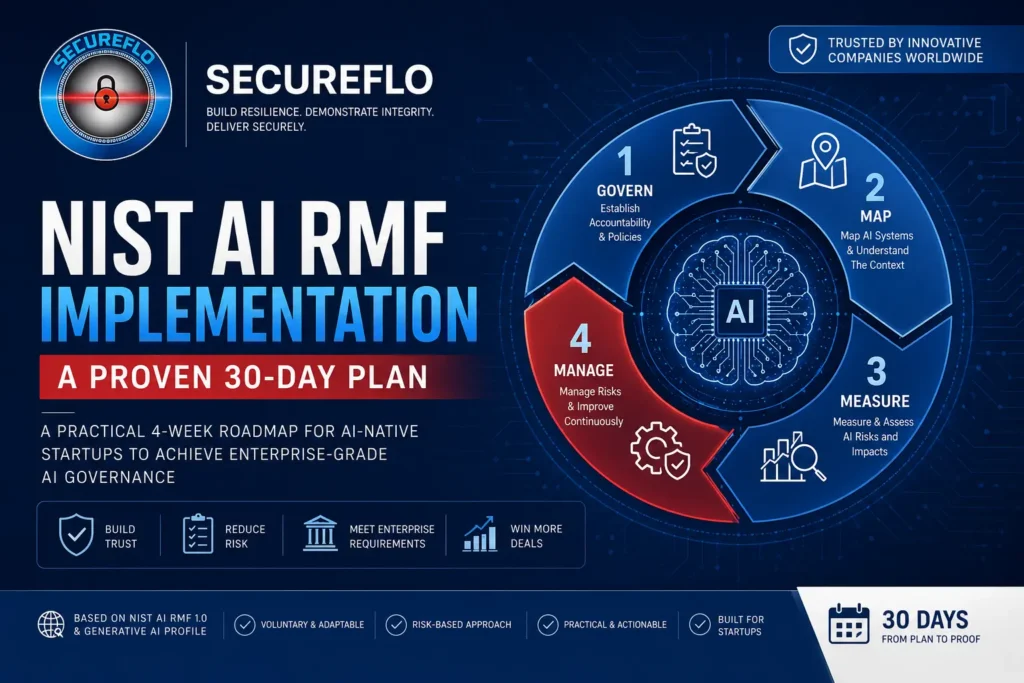
Most published NIST AI RMF implementation guides quietly assume you’re a Fortune 500 enterprise with a dedicated AI governance committee, an in-house compliance team, and 12 months to spend. If you’re a CTO at a Series A–C AI startup, none of that applies. You have three months of runway to close a $250K enterprise deal that just landed a 47-question AI security review in your inbox.
The good news: NIST AI RMF was designed with lean adoption in mind. NIST’s own guidance describes the framework as voluntary, rights-preserving, non-sector-specific, and use-case agnostic. Lightweight adoption is a stated goal, not a compromise.
Concrete evidence: NIST AI RMF 1.0 was released January 26, 2023, with the companion Playbook following March 30, 2023. The Generative AI Profile (NIST AI 600-1) — released July 26, 2024 — added 400+ suggested actions across 12 GenAI-specific risk categories. All of it is free, and the Playbook explicitly gives organizations discretion on which suggested actions apply.
The startup advantage: you have no legacy AI governance program to unwind. You can build the right thing on the first pass, mapped directly to the framework, using artifacts an enterprise reviewer will recognize.
The urgency: Boston Consulting Group’s December 2025 study of 500 senior security leaders found that 60% of organizations experienced an AI-powered cyberattack in the past year, while only 7% have deployed AI defenses. Your enterprise customer’s CISO is under board pressure to translate that asymmetry into vendor security requirements — and NIST AI RMF alignment is the language they’re using.
This guide is the four-week NIST AI RMF implementation plan we run with AI-native startups at SecureFlo. Every week maps to one of NIST’s four core functions. Every week produces artifacts your enterprise buyer’s security review will accept in writing.
Let’s start.
NIST AI RMF is built around four interconnected functions. NIST AI RMF implementation, when done right, means running all four continuously — not once. But you have to start somewhere. The 30-day plan below establishes each function as a working operating rhythm.
| Week | Function | What you build | What you can defend |
|---|---|---|---|
| Week 1 | Govern | Charter, policy, roles, risk tolerance | “We have accountability” |
| Week 2 | Map | AI system inventory, categorization, third-party register | “We know what we run” |
| Week 3 | Measure | Testing methodology, metrics, evaluation baseline | “We test what we build” |
| Week 4 | Manage | Incident response, evidence collection, review cadence | “We respond and improve” |
That order matters. You can’t map what you haven’t chosen to govern. You can’t measure what you haven’t mapped. You can’t manage what you haven’t measured. The 30-day sequence follows the natural build order NIST intended.
The Govern function is where NIST AI RMF implementation starts, and where most startups skip ahead. Don’t. Every artifact produced in Weeks 2–4 depends on the accountability and risk tolerance you establish here.
Per NIST AI RMF 1.0, the Govern function covers: policies and procedures, accountability structures, workforce competencies, safe AI commitments, stakeholder engagement, and third-party AI risk. For a startup, most of this can be documented in a week if you keep it concrete.
By end of Week 1 you should have: an AI Governance Charter, an AI Acceptable Use Policy, a written risk tolerance statement, and a RACI matrix. Four artifacts. All dated. All signed by the CEO or CTO. This is the foundation everything else attaches to.
The Map function is where the concrete work of NIST AI RMF implementation lives. NIST defines Map as context establishment — categorizing every AI system, identifying its purpose, benefits, risks, and dependencies. In practice, this is your AI inventory.
Why it matters: IBM’s Cost of a Data Breach Report 2025 found that organizations with high levels of shadow AI incurred an average of $670,000 in higher breach costs, and 97% of organizations experiencing AI-related breaches lacked proper AI access controls. You cannot govern what you have not mapped.
By end of Week 2 you should have: a comprehensive AI system inventory, categorization per NIST AI RMF taxonomy, a third-party AI vendor register, and at least one full AI impact assessment on your highest-risk system. This is what an auditor or enterprise reviewer will spend most of their time on.
The Measure function requires evaluating your AI systems against trustworthy characteristics: validity, reliability, safety, security, resilience, accountability, transparency, explainability, privacy, and fairness. For a startup, Week 3 is about establishing a testing methodology you can prove is running — not building perfect metrics.
By end of Week 3 you should have: a testing methodology document, baseline metrics for each AI system, model-version governance documented, a red-team cadence plan, and a user feedback mechanism. You now have evidence you test what you build — not just claim you do.
The Manage function is where NIST AI RMF implementation transitions from a project into an operating rhythm. This is also where most startups fail — they build the artifacts and then never update them.
By end of Week 4 you should have: an AI-specific incident response plan, a continuous evidence collection process, a quarterly review cadence scheduled, a control-mapping matrix, and a Day 30 summary artifact. NIST AI RMF implementation, defensibly complete.
By Day 30, a startup running the plan above will have produced these 14 artifacts. Every one of them is something an enterprise security reviewer or auditor will accept.
Fourteen dated, signed documents. That’s what “defensible NIST AI RMF implementation” looks like at Day 30. It’s less than most founders assume — and more than most competitors have.
After running gap analyses for dozens of AI-native startups over the past twelve months, the same failure patterns keep showing up. Avoid these and Day 30 becomes a real turning point instead of a compliance theater exercise.
Mistake 1: Paper governance. Policies that live in Notion and never appear in operational decisions. Enterprise reviewers spot this in five minutes.
Fix: your AI governance committee meeting minutes need to reference the policies you actually wrote — that’s the connection auditors look for.
Mistake 2: Retrofitted evidence. Reconstructing artifacts when an auditor asks. Always weaker, costlier, and less credible than creating them as the work happens.
Fix: dated Slack messages, logged reviews, and signed acknowledgments generated in the natural flow of work.
Mistake 3: Marketing-page NIST AI RMF alignment. A “Trust” page claiming NIST AI RMF alignment without the underlying artifacts. When a reviewer asks for the impact assessment, you have to produce it.
Fix: publish the artifacts first, the marketing page second.
Mistake 4: Skipping the SOC 2 / ISO 27001 base. NIST AI RMF sits on top of your information security foundation. Trying to run NIST AI RMF implementation without a baseline SOC 2 program adds months to the timeline and confuses reviewers.
Fix: run them in parallel or sequence — but don’t skip the base.
Mistake 5: Treating it as a one-time project. NIST AI RMF is a continuous cycle. Organizations that produce artifacts at Day 30 and never update them fail the second-year audit — and the enterprise renewal review.
Fix: quarterly review cadence, on the calendar, with named owners.
Mistake 6: Confusing NIST AI RMF with the EU AI Act. NIST AI RMF is voluntary. The EU AI Act is binding regulation. They complement each other; they don’t substitute. Founders who conflate them end up under-prepared for the framework their customer actually cares about.
Fix: understand which framework each of your customers references and align to all of them (it’s not as hard as it sounds).
The 30-day plan gets you to defensible. It doesn’t get you to certified — because NIST AI RMF has no certification. It doesn’t get you to fully mature — because maturity is a 12–24 month evolution.
What Day 30 does: it gives you a working NIST AI RMF implementation you can defend in writing. Enterprise security reviews close in 5–10 business days instead of 4–8 weeks. Board questions get answered with evidence, not hand-waving. Investor diligence on AI risk resolves in one conversation.
From there, the natural next steps are: mapping your NIST AI RMF implementation to ISO 42001 (typically 3–6 months, especially if you already have ISO 27001 or SOC 2 Type II), running your first external audit or third-party assessment, and adopting the NIST AI 600-1 Generative AI Profile suggested actions for the risk categories most relevant to your product.
For teams that want to maintain the continuous evidence rhythm without spending 20% of their engineering time on it, tools like Knowledge by SecureFlo (knowledge.secureflo.net) exist to make that lift smaller. The free 10-minute Security Readiness Assessment on the platform maps your current posture against NIST AI RMF, ISO 42001, EU AI Act, SOC 2, HIPAA, GDPR, and DPDP — and produces a personalized readiness score, prioritized gap list, and board-ready PDF report. Useful whether you’re at Day 3 of NIST AI RMF implementation or Day 300.
NIST AI RMF adoption is now the leading AI governance signal in enterprise procurement. Hitch Partners’ 2026 Global CISO Leadership Report found NIST AI RMF at 57–67% CISO adoption. Colorado’s AI Act allows deployers to satisfy obligations via NIST AI RMF alignment. Texas offers NIST AI RMF alignment as an affirmative defense. Federal contracting paths reference it.
Translation: NIST AI RMF implementation is no longer optional for AI startups selling into US enterprise. It’s the baseline expected posture. The World Economic Forum’s Global Cybersecurity Outlook 2026 reports that the share of organizations assessing AI tool security before deployment nearly doubled from 37% in 2025 to 64% in 2026. Enterprise CISOs are asking. Startups that answer in writing win the deals.
The good news is exactly what this guide argues: a defensible NIST AI RMF implementation for an AI-native startup is 30 focused days of work. Not 12 months. Not a $200K consulting engagement. Follow the four-function plan above, produce the 14 artifacts, and the Day 30 summary becomes the document that closes your next enterprise deal.
Q: How long does NIST AI RMF implementation actually take?
A: For a startup, defensible implementation is achievable in 30 days using the four-function plan (Govern, Map, Measure, Manage). Fuller foundational adoption typically takes 3–6 months. Enterprise-scale implementation runs 6–12 months. The framework itself is voluntary, and NIST explicitly supports lightweight adoption.
Q: Is NIST AI RMF mandatory for AI startups?
A: No. NIST AI RMF is a voluntary framework. But it is effectively required by enterprise procurement in many sectors — Hitch Partners’ 2026 CISO Leadership Report shows 57–67% CISO adoption. Colorado’s AI Act allows deployers to satisfy obligations via NIST AI RMF, and Texas offers alignment as an affirmative defense. For AI startups selling into US enterprise or regulated industries, NIST AI RMF alignment is the baseline expected posture.
Q: What are the 4 functions of NIST AI RMF?
A: The four core functions are Govern (organizational policies, accountability, risk tolerance), Map (categorization of AI systems, context establishment, impact assessment), Measure (testing, evaluation, metrics for trustworthy characteristics), and Manage (risk response, incident handling, continuous improvement). They form a continuous cycle, not a sequential checklist.
Q: What is NIST AI 600-1?
A: NIST AI 600-1 is the Generative AI Profile, released July 26, 2024. It defines 12 GenAI-specific risk categories (including confabulation/hallucination, data privacy, harmful bias, information integrity, information security, intellectual property, and value chain risks) and includes 400+ suggested actions mapped to the four core NIST AI RMF functions. It’s the most detailed public taxonomy of GenAI risk currently available.
Q: What documentation does NIST AI RMF implementation require?
A: There is no fixed documentation list because NIST AI RMF is a framework, not a certification. A defensible startup implementation at Day 30 typically produces 14 artifacts: AI Governance Charter, AI Acceptable Use Policy, Risk Tolerance Statement, RACI matrix, AI System Inventory, Third-Party AI Vendor Register, Impact Assessments, Testing Methodology, Baseline Metrics, Model Version Governance, Red-Team Plan, AI Incident Response Plan, Continuous Evidence Collection SOP, and a Day 30 Summary Artifact.
Q: NIST AI RMF vs ISO 42001 — which should a startup implement first?
A: For most AI startups, NIST AI RMF first. It’s free, faster to adopt (2–4 weeks lightweight vs. 4–12 months for ISO 42001 certification), and the underlying risk methodology transfers directly into ISO 42001 if you certify later. ISO 42001 sits on top of NIST AI RMF operationally. Most startups use NIST AI RMF as the operational rhythm and add ISO 42001 as the certifiable management-system layer when procurement demands it.
Q: Does NIST AI RMF have a certification?
A: No. NIST AI RMF is a voluntary framework without formal certification. Organizations self-attest to alignment. External assessment (by consulting firms, auditors, or automated compliance platforms) is available but is not a formal NIST certification. If you need a certifiable AI management standard, ISO 42001 is the alternative.
Q: How does NIST AI RMF relate to the EU AI Act?
A: They complement each other. The EU AI Act is binding regulation for AI systems used in the EU. NIST AI RMF is a voluntary risk methodology that can help demonstrate due diligence toward EU AI Act obligations, particularly around impact assessment and risk management. Many organizations use NIST AI RMF as the operational methodology underneath their EU AI Act compliance program.
If your AI startup is preparing for its first enterprise security review — or already losing deals to compliance gaps — the first step is knowing where you stand.
Knowledge by SecureFlo (knowledge.secureflo.net) is a free, 10-minute Security Readiness Assessment built for AI-native startups. It maps your current posture against NIST AI RMF’s four functions, ISO 42001, the EU AI Act, SOC 2, HIPAA, GDPR, and DPDP — and produces a readiness score, a prioritized gap list, and a board-ready PDF report you can bring into your next enterprise deal.
No demo gate. No sales call required. The report is the value.
→ Run your Security Readiness Assessment: knowledge.secureflo.net
Free assessment from Secureflo. Calibrated to your industry, country, and stack. Get immediate visibility into your institutional grade reliability.