
Key Takeaways
Twelve months ago, “AI governance for startups” was a phrase boards talked about and engineers ignored. In 2026, it’s a line item in enterprise procurement questionnaires — and the line item that stalls AI startup deals more often than any other.
The shift wasn’t subtle. Boston Consulting Group’s December 2025 study of 500 senior security leaders found that 60% of organizations report experiencing an AI-powered cyberattack in the past year, while only 7% have deployed AI-enabled defenses. That asymmetry is what enterprise CISOs are now defending against — and the way they defend is by pushing risk down the supply chain, into your security review.
The World Economic Forum’s Global Cybersecurity Outlook 2026 (804 respondents, 92 countries) found that the share of organizations assessing AI tool security before deployment nearly doubled from 37% in 2025 to 64% in 2026. PwC’s 2026 Global Digital Trust Insights (3,887 executives across 72 countries) ranks AI as the #1 cyber investment priority. Hitch Partners’ 2026 Global CISO Leadership Report puts third-party risk at the top of CISO concerns at 43% — nearly double AI-enhanced attacks at 22%.
For your enterprise buyer, your AI startup IS the third-party risk.
The economic translation, in concrete terms: a security review for a vendor with documented AI governance, SOC 2 Type II, and recent pen tests typically closes in 5–10 business days. The same review for a vendor without those artifacts stretches to 4–8 weeks. On a $250K ACV deal closing at quarter-end, that gap is the difference between making the quarter and missing it.
This article is for AI startup founders and CTOs who have heard the phrase “AI governance for startups” but haven’t yet untangled what ISO 42001, NIST AI RMF, and the EU AI Act actually require — and how to put a defensible program in place in 30–45 days instead of 12 months.
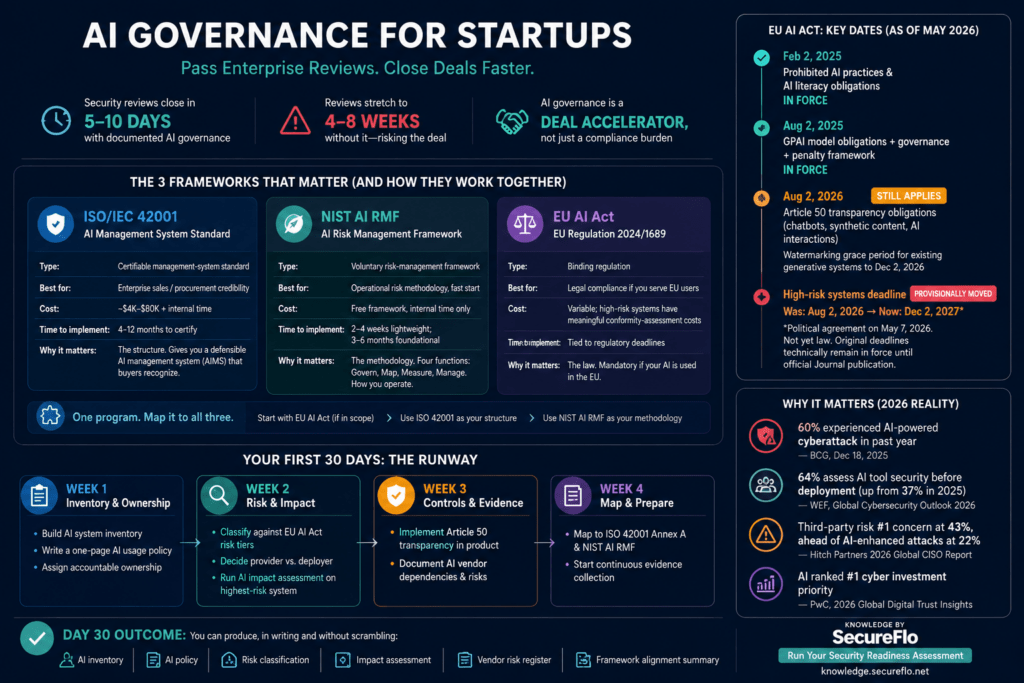
Most “AI governance” content treats ISO 42001, NIST AI RMF, and the EU AI Act as three options. They’re not. They’re three complementary layers serving different purposes. Confusing them is the most expensive mistake we see at Series A–C AI startups.
| Dimension | ISO/IEC 42001 | NIST AI RMF | EU AI Act |
|---|---|---|---|
| Type | Certifiable management-system standard | Voluntary risk-management framework | Binding regulation |
| Mandatory? | Voluntary, but increasingly required by enterprise procurement | Voluntary, referenced across US federal procurement | Mandatory if your AI is used in the EU |
| Best for | Enterprise sales / procurement credibility | Operational risk methodology, fast lightweight start | Legal compliance if you serve EU users |
| Cost | ~$4K–$80K + internal time | Free framework, internal time only | Variable; high-risk systems have meaningful conformity-assessment costs |
| Time to implement | 4–12 months to certify | 2–4 weeks lightweight; 3–6 months foundational | Tied to regulatory deadlines |
| Recognition by enterprise buyers | Rising fast — “the new SOC 2 for AI” | Common procurement vocabulary | Legal baseline, not a sales differentiator |
The practical sequencing for AI governance for startups at Series A–C stage:
You don’t have to pick. You map one program to all three.
For AI governance for startups, this is the biggest regulatory shift of the year — and most published content hasn’t caught up. The regulatory ground shifted as recently as May 7, 2026.
On May 7, 2026, the Council of the European Union and the European Parliament reached provisional political agreement on the “AI Act Omnibus” — part of the EU’s broader Digital Omnibus simplification package. The agreement would:
Critical nuance most articles miss: As of this writing, the Omnibus is a provisional political agreement, not adopted law. It still requires formal endorsement by Parliament and Council, legal-linguistic revision, and publication in the EU’s Official Journal. Until that happens, the original August 2, 2026 deadlines technically remain in force. Adoption is widely expected before that date, but no startup should bet its compliance plan on a regulation that has not yet been published.
Two things are still binding August 2, 2026, regardless of the Omnibus:
Bottom line for AI governance for startups: plan against the original August 2, 2026 deadline. If the Omnibus is formally adopted before then, you’ve earned an extra 16 months. If it isn’t, you’re still ready.
Within AI governance for startups, ISO 42001 is the standard rising fastest. Published in December 2023, ISO/IEC 42001 is the world’s first AI management system (AIMS) standard. Its rise from “novel” to “expected” took less than two years.
The signal: Microsoft 365 Copilot, Google Cloud (including Workspace and Gemini), AWS, and SAP have all achieved third-party ISO 42001 certification for their AI services. When the largest AI vendors in the world treat ISO 42001 as table stakes, enterprise procurement treats it as a checkbox — and your enterprise buyer’s CISO knows it.
ISO 42001 follows the Annex SL High-Level Structure shared with ISO 27001 and ISO 9001 — ten clauses plus an Annex A control set (approximately 38 controls across 9 objectives). It uses the same Plan-Do-Check-Act lifecycle that information-security teams already know. If you’ve done SOC 2 or ISO 27001, the operating rhythm is familiar.
Required documentation includes: an AI Policy, AIMS scope statement, AI risk management methodology, Statement of Applicability, AI risk treatment plan, and an AI impact assessment per the ISO 42005:2025 guidance. The impact assessment is consistently cited as the highest-effort artifact — and the one most commonly missing at startups.
Vanta’s State of Trust Report (survey of 3,500 IT and business leaders across the US, UK, France, Germany, and Australia) found that only 37% of organizations currently conduct or are in the process of conducting regular AI risk assessments, and just 36% have or are putting an AI policy in place. Translation: roughly two-thirds of the companies your enterprise buyer evaluates have nothing material to show on AI governance for startups. Being in the top third is achievable in 30–45 days.
The most common mistake in AI governance for startups is treating it as a quarterly initiative requiring a six-figure consultant. It’s not. The first 30 days have a concrete, defensible sequence.
You should be able to produce, in writing and without scrambling: an AI system inventory; an AI policy; a documented risk-classification approach; an impact assessment for your highest-risk system; a vendor risk register for your AI dependencies; and a one-page summary of which frameworks you’re aligning to. That’s the bar for AI governance for startups — and it’s lower than most founders assume.
Knowing the question categories is half the work of AI governance for startups. Modern AI-specific questionnaires consistently probe seven areas:
A startup that can answer these seven categories in writing with current dated artifacts closes enterprise security reviews dramatically faster than one that can’t.
The forward-looking dimension of AI governance for startups is shifting fast enough that teams still building their first program need to anticipate, not react.
Gartner projects that 40% of enterprise applications will integrate task-specific AI agents by the end of 2026, up from less than 5% today (Gartner press release, August 26, 2025). The implication: AI agents acting with system-level access — calling tools, modifying data, executing transactions — become a new identity category that traditional IAM doesn’t cover. The 2026 CISO AI Risk Report found that 83% of CISOs and CIOs are concerned about AI access, and 47% have already observed AI agents exhibiting unintended or unauthorized behavior.
The governance posture this requires:
This is also where the broader category shift is happening: from point-in-time governance (annual audit scrambles) to continuous governance (always-on evidence, real-time framework mapping, monitored drift). The fragmentation cost of point-in-time governance — separate threat feeds, separate regulatory monitoring, separate compliance dashboards, separate executive reporting — is one of the loudest complaints from security leaders at growing startups.
Platforms like Knowledge by SecureFlo (knowledge.secureflo.net) exist to close that fragmentation. The approach is straightforward: a single intelligence layer that maps your current AI governance posture against frameworks (ISO 42001, NIST AI RMF, EU AI Act, SOC 2, HIPAA, GDPR, DPDP), tracks regulatory shifts as they happen (like the May 7, 2026 Omnibus agreement), and produces the audit-ready artifacts enterprise reviewers actually ask for. The free 10-minute Security Readiness Assessment is the entry point — it produces a personalized readiness score, a prioritized gap list, and a board-ready PDF report.
The product point is small. The structural point is larger: an AI governance for startups program that operates as continuous intelligence closes enterprise deals faster than one that operates as a once-a-year project.
After running gap analyses for dozens of AI-native startups in the last twelve months, the same handful of mistakes show up consistently:
The framing that matters most: AI governance for startups is not a compliance tax. It’s a deal accelerator.
The same documentation that lets you pass an enterprise security review in 5 days instead of 6 weeks lets you close the deal. The same policy that satisfies a procurement reviewer also satisfies your investor’s diligence on AI risk. The same AI inventory that maps to ISO 42001 Annex A controls also serves your board’s quarterly risk review.
Treat AI governance as infrastructure. Build it once, layer it onto every framework your customers ask about, keep it current with continuous evidence, and let it compound into a competitive advantage that takes your slower competitors months to replicate.
The startups winning enterprise AI deals in 2026 aren’t the ones with the most features. They’re the ones whose buyers can verify, in writing, that AI risk is governed, documented, and defensible. That’s a 30–45 day program. Not a six-month consulting engagement.
Q: What is AI governance for startups?
A: AI governance for startups is the set of policies, controls, and documented practices that govern how an AI startup builds, deploys, and monitors AI systems. For Series A–C startups, it typically means aligning to three frameworks — ISO 42001 (management system), NIST AI RMF (risk methodology), and the EU AI Act (legal compliance if you serve EU users) — and producing the artifacts enterprise security reviewers ask for.
Q: Do AI startups need ISO 42001 certification?
A: It depends on who you sell to. If you’re selling AI software to enterprise buyers, ISO 42001 is rapidly becoming a procurement expectation — the “new SOC 2 for AI.” Microsoft, Google Cloud, AWS, and SAP have all certified their AI services. For early-stage startups not yet selling to enterprise, ISO 42001 alignment (without certification) is usually enough; certification becomes worthwhile when enterprise contracts depend on it.
Q: When does the EU AI Act apply to AI startups?
A: The EU AI Act applies to any AI system used in the EU, put into service in the EU, or producing output used in the EU — regardless of where the provider is located (Article 2). For US startups, this typically means: if any of your customers, users, or output recipients are in the EU, you’re in scope. Prohibited practices have applied since February 2025. GPAI obligations since August 2025. High-risk system obligations apply from August 2, 2026, with a provisional amendment (the May 2026 “Omnibus”) that may extend this to December 2, 2027 once formally adopted.
Q: How long does ISO 42001 certification take for a startup?
A: Typically 4–6 months if you already have ISO 27001 or SOC 2 Type II, and 6–12 months from scratch. The two-stage external audit alone (Stage 1 documentation review, Stage 2 audit) takes several weeks. Startups with existing information-security programs benefit because ISO 42001 sits on top of ISO 27001 and reuses much of its control architecture.
Q: How much does ISO 42001 cost for a startup?
A: Direct certification costs typically range from $4,000–$25,000 for narrowly-scoped startup implementations, and $15,000–$80,000 for broader scope. This excludes internal time, which is the larger cost. Total cost is heavily reduced if you’ve already implemented ISO 27001 or SOC 2 — control overlap reduces implementation effort by roughly 40–50%.
Q: ISO 42001 vs NIST AI RMF — which should an AI startup use?
A: Both. NIST AI RMF provides the risk methodology — the four functions (Govern, Map, Measure, Manage) for operating an AI risk program. ISO 42001 provides the management system structure — clauses and Annex A controls that auditors and procurement teams recognize. NIST AI RMF is free and faster to adopt; ISO 42001 is certifiable and increasingly required by enterprise buyers. Most startups use NIST AI RMF as the operational layer underneath ISO 42001’s management system.
Q: What is Article 50 of the EU AI Act, and does it apply to my startup?
A: Article 50 requires that users be informed when they’re interacting with AI (chatbots, voice assistants, copilots) and that synthetic outputs (audio, image, video, text) be marked in a machine-readable format. It applies from August 2, 2026 — this date was NOT changed by the May 2026 Omnibus amendment. If your product has a chatbot, AI-generated content, or AI-driven recommendations affecting EU users, Article 50 applies to you.
Q: What’s the fastest way to start AI governance for startups?
A: A 30-day program is feasible. Week 1: AI system inventory, one-page AI policy, named owner. Week 2: risk classification against EU AI Act tiers, impact assessment on highest-risk system. Week 3: transparency disclosures in product UX, third-party AI vendor risk register. Week 4: control mapping to ISO 42001 and NIST AI RMF, continuous evidence collection cadence. The Security Readiness Assessment at knowledge.secureflo.net produces a personalized baseline in about 10 minutes.
If your AI startup is heading into enterprise security reviews in 2026 — or already losing weeks on questionnaires you can’t answer fast enough — the first step is knowing where you stand.
Knowledge by SecureFlo (knowledge.secureflo.net) is a free, 10-minute Security Readiness Assessment built for AI-native startups. It maps your current posture against ISO 42001, NIST AI RMF, the EU AI Act, SOC 2, HIPAA, GDPR, and DPDP — and produces a readiness score, a prioritized gap list, and a board-ready PDF report.
No demo gate. No sales call required. The report is the value.
→ Run your Security Readiness Assessment: knowledge.secureflo.net
Stay informed as the regulatory landscape shifts — including the EU AI Act Omnibus, Article 50 enforcement, and emerging frameworks for agentic AI governance — through The Readiness Briefing, our bi-weekly newsletter for AI startup founders, CTOs, and security leaders.
Free assessment from Secureflo. Calibrated to your industry, country, and stack. Get immediate visibility into your institutional grade reliability.